




Small Town America Celebrations
07/08/2026
By: Chad Biggs
Across the country, cities staged their biggest Fourth of July in a generation. In the Magic Valley, it looked and felt like home.
In Rupert, Idaho, that meant birthday cake.
For 34 years, Sally Gibbons managed donations and sponsorships for the Rupert Fourth of July Committee, a 13-person all-volunteer operation that filled the town’s downtown park with concerts, a race, a rodeo, a parade, and fireworks. “When you come to the celebration,” she says, “it’s almost like a step into a Norman Rockwell painting: older people, younger people, food booths on all three sides of the square, just people visiting.”
Fireworks and Freedom Fests
Rupert’s theme this year was “250 years strong,” which was two years in the making. New additions included said birthday cake for the country, trivia from the gazebo, and a second night of fireworks on July 3. On parade day, police estimated 10,000 to 12,000 people turned out. “Class reunions schedule around the fourth,” Gibbons says. “People come home for it.”
In Jerome, City Clerk Bernadette Coderniz coordinated Freedom Fest through the city’s Community Spirit Committee, which has been building the celebration since 2016. Jerome made a deliberate choice most communities don’t: Freedom Fest was held the week before July 4, not on the holiday itself. “We feel that the actual day of Independence Day should be for families,” Coderniz says. The event added a larger fireworks display and two Spuddy Buddies, Idaho’s America 250 mascot characters, to greet the crowds.
In Twin Falls, Kyle Tarbet had two events on his calendar. The Twin Falls Area Chamber of Commerce hosted an America 250 family festival at the Visitor Center on June 27, with music, historic re-enactments, a cornhole tournament, and a patriotic program. July 4 brought the annual celebration at the College of Southern Idaho campus, with the city municipal band and an extra-large fireworks show. “People here are very patriotic,” says Tarbet, the Chamber’s president and CEO. “America 250 just gives us an extra chance to scale up.”
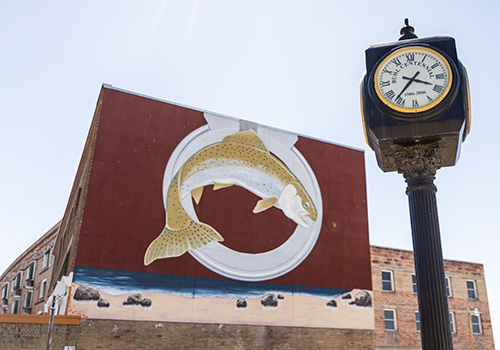
Buhl’s version had been building for years. Jeff Gabardi, a retired U.S. Forest Service employee who volunteers with the West End Men’s Association, helped coordinate the Sagebrush Days parade, which drew roughly 100 entries through Broadway each year. A pre-parade fish fry nodded to Buhl’s history as a onetime trout capital. A fun run brought nearly 400 participants. “The whole town doubles or triples in size,” Gabardi says.
But ask what the milestone meant to the people behind it, and the answers reached back much further than the weekend.
What This Milestone Means Here
Tarbet sees it as something specific to this part of Idaho. “Our area is a microcosm of the American dream,” he says. “It was settled by people who came here seeking religious freedom, who wanted to be landowners, or who were disrupted by things like the Dust Bowl and had to start all over, and found Southern Idaho to be a place they could raise their family.”
Gabardi points to Buhl’s cemetery. “If you go out to our cemetery, you’ll see names from all over Eastern Europe,” he says. “Those date back over 100 years now. They migrated to the United States simply for a better life, and then to Idaho for a better life too.” Farm workers and dairy workers continue that migration today, he says.
For Gibbons, the milestone is personal: her grandfather arrived as a homesteader when Rupert was founded in 1906, and those roots, she says, shape the celebration’s spirit each year.
First Federal Bank was in the picture across all four towns. In Buhl, First Fed employees marched in the Sagebrush Days parade; Foundation grants have supported library upgrades and local sports facilities. In Jerome, First Fed was a silver sponsor of Freedom Fest, running a watermelon eating contest for kids at their booth. AVP/Area Retail Banking Manager Loralee McKee also serves on the Community Spirit Committee. In Twin Falls, Tarbet pointed to the bank’s Rock Paper Scissors tournament, a community fundraiser, as the kind of civic presence that goes beyond a check.
Large events took everyone working together, Tarbet says. Gibbons’s committee had met monthly since January; Gabardi handled parade entries and road closures.
The picture Sally Gibbons has been describing for 34 years was there again this summer: the food booths, the neighbors, the chairs arranged toward the gazebo. The fireworks, this year, were bigger. Everything else, she suspected, felt about the same.